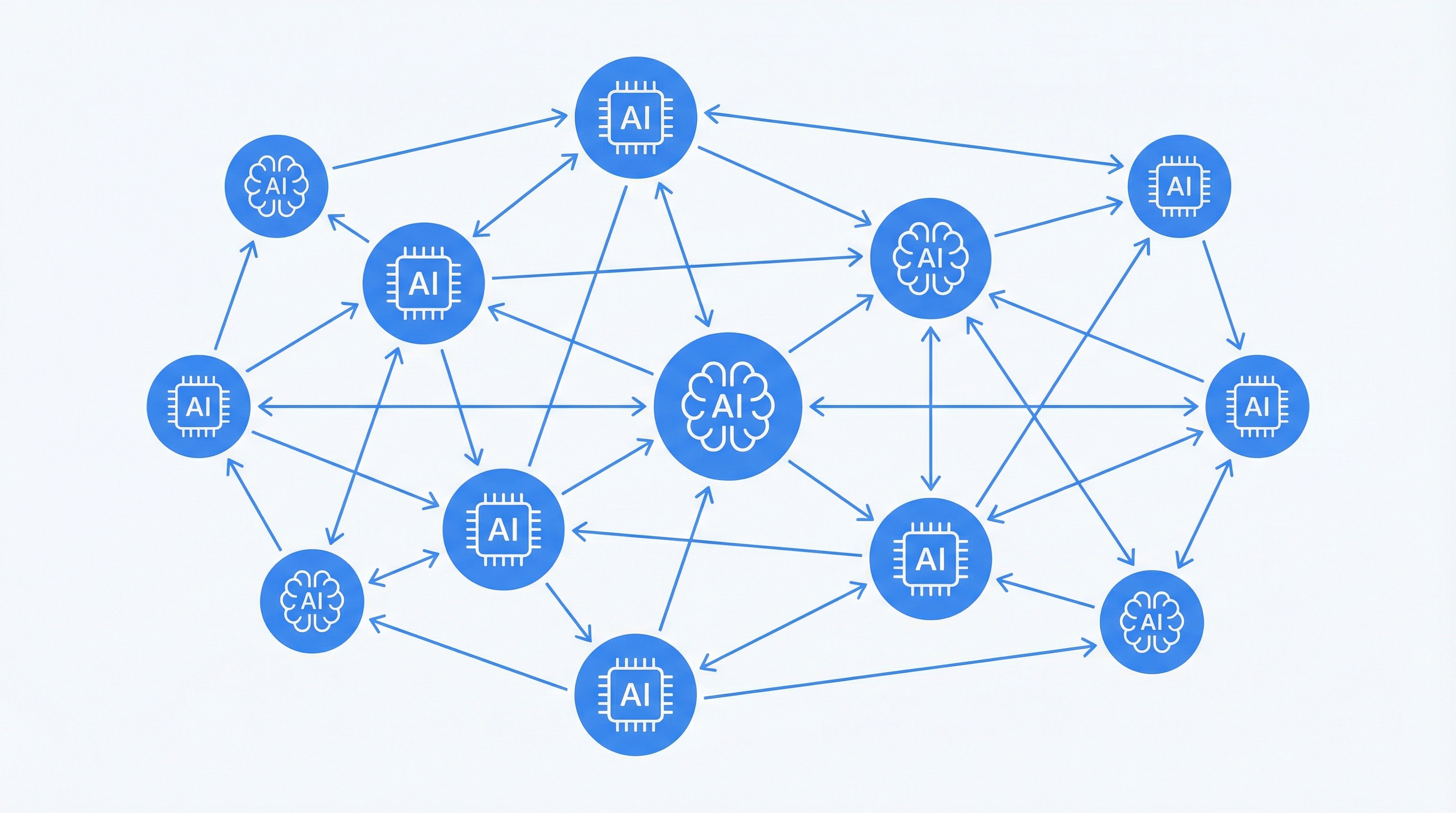
Multi-Agent Orchestration
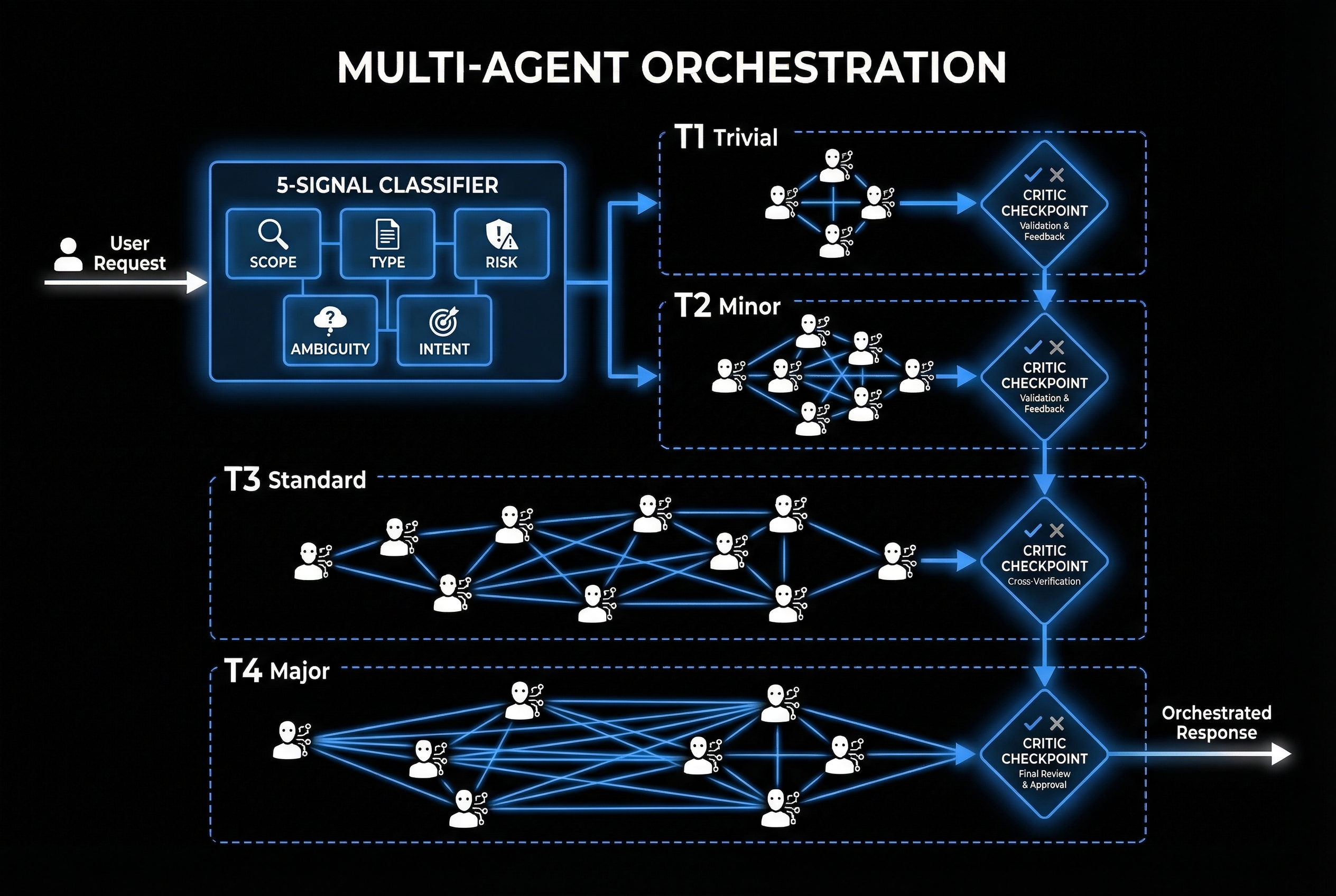
Twenty-seven specialized agents, each purpose-built for a distinct capability. A 5-signal classification engine routes every request to the right agent at the right quality bar — no guesswork, no manual dispatch.
How It Works
From user intent to validated delivery in six deterministic steps.
User Request
Natural language input enters the orchestration layer
5-Signal Classification
Scope, type, risk, ambiguity, and intent sensitivity are scored
Tier Assignment
Signals map to T1 Trivial, T2 Minor, T3 Standard, or T4 Major
Agent Routing
Capability-matched agent receives the task with tier context
Critic Review
Independent critic validates output against tier requirements
Delivery
Validated output returned with provenance and quality metadata
Key Capabilities
The building blocks of intelligent agent coordination.
Intent Engineering
Every request is evaluated across five signals — scope, type, risk, ambiguity, and intent sensitivity. This multi-dimensional classification eliminates the brittleness of keyword matching and ensures the right agent receives the right task at the right quality bar.
Tiered Quality Gates
Four tiers (T1 Trivial through T4 Major) define escalating review requirements. A T1 config change skips heavy review. A T4 architecture decision gets full BRD treatment, critic validation, and structured handoff documentation.
BRD-Driven Development
Business requirements documents flow through a structured spec-to-code pipeline. Requirements are decomposed into architectural decisions, implementation tasks, and review criteria before any agent writes a line of code.
Critic Checkpoints
An independent critic agent validates output at every tier boundary. Critics evaluate against tier-specific criteria — not generic checklists — catching issues that self-review consistently misses.
Capability-Based Handoffs
Agents are selected by capability match, not by name or static routing tables. When requirements shift mid-task, the orchestrator re-evaluates and hands off to a better-matched agent with full context preservation.
Spec-to-Code Pipeline
The complete pipeline from requirements through architecture, implementation, and review is automated. Each stage produces artifacts that feed the next, creating an auditable trail from business need to production code.
Why It Matters
Single-agent systems hit a wall. They apply the same level of effort to a typo fix and a database migration. They lack the specialized knowledge to handle security reviews, infrastructure changes, and UI work with equal competence. They cannot validate their own output.
Multi-agent orchestration solves this by matching task complexity to agent capability. The 5-signal classification means a simple rename gets fast-tracked through T1 with minimal overhead, while a breaking API change gets the full T4 treatment with BRD, architecture review, and critic validation. Twenty-seven agents means deep specialization — not one model trying to be everything.
The result: higher quality output, faster turnaround on simple tasks, and an auditable trail that shows exactly why each decision was made and who (or what) validated it.