Persistent Vector Memory
Agents that remember. Qdrant vector search and Ollama embeddings give every session access to accumulated knowledge — procedures that worked, mistakes to avoid, and context that would otherwise be lost at session end.
The 6 MCP Tools
Purpose-built tools for every type of knowledge operation.
How It Works
From agent observation to compounding organizational knowledge.
Agent Learns
Observation, decision, or outcome identified as worth preserving
memory_store
Knowledge classified by type, tagged, and sent to the MCP server
Qdrant Indexes
nomic-embed-text generates vectors; Qdrant indexes for similarity search
Future Recall
New sessions invoke memory_recall; relevant knowledge surfaces automatically
Knowledge Compounds
Each session adds to the knowledge base; organizational intelligence grows
Dual-Path Architecture
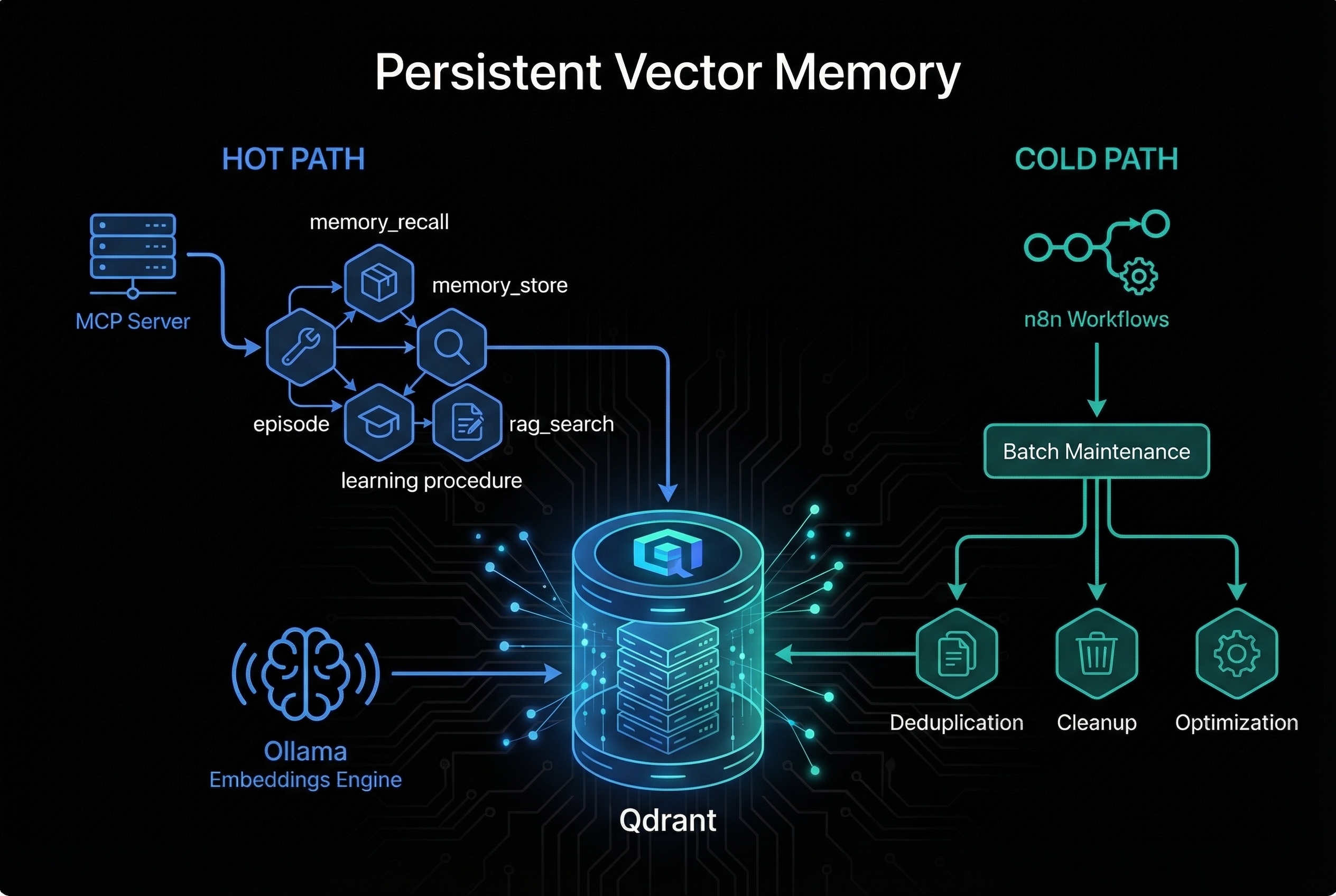
Real-time operations and batch maintenance run on separate paths.
Interactive Operations
- memory_recall and memory_store during active sessions
- Sub-second vector search via Qdrant
- Ollama embedding generation on demand
- Deduplication checks before every store operation
- SessionStart auto-recall for context restoration
Background Operations
- Scheduled deduplication and consolidation
- Memory promotion from scratch to permanent
- Embedding re-indexing when models update
- Stale memory detection and archival
- Cross-collection knowledge graph updates
Key Capabilities
Structured knowledge that compounds over time.
6 MCP Tools
Purpose-built tools for every knowledge operation: recall, store, RAG search, episodes, learnings, and procedures/trajectories. Each tool has a specific schema and validation — no generic key-value dumping.
Semantic Search
Qdrant vector database with nomic-embed-text embeddings enables similarity search that understands meaning, not just keywords. A query about "database migration failures" surfaces memories about schema rollbacks even if those words never appeared.
Hot/Cold Path
The MCP server handles real-time operations during sessions — recall, store, search. Batch maintenance runs asynchronously: deduplication, consolidation, re-indexing, and stale memory archival happen without blocking active work.
Cross-Session Transfer
Knowledge persists across sessions and accumulates over time. An agent that solves a tricky deployment issue in Session 1 recalls that solution in Session 47 when a similar problem appears — without being told to look for it.
Memory Types
Five structured types — episodes, learnings, procedures, trajectories, and RAG documents — each with distinct schemas. Episodes capture what happened. Learnings capture what was verified. Procedures capture how to do it again.
Organizational Intelligence
Individual agent memories compound into institutional knowledge. Patterns emerge across sessions: which approaches work for which problems, which configurations cause issues, which reviews catch which classes of bugs.
Why It Matters
Every AI session today starts from zero. The agent has no memory of yesterday's debugging session, last week's architecture decision, or the deployment procedure that took three attempts to get right. Context windows are finite, and when they end, everything learned evaporates.
Persistent vector memory changes the economics of AI assistance. Instead of re-explaining context at the start of every session, agents auto-recall relevant knowledge. Instead of rediscovering solutions to problems that were already solved, agents surface past procedures. Instead of repeating mistakes, agents recall learnings about what did not work and why.
The compounding effect is the real value. After 100 sessions, the memory system contains a rich, searchable knowledge base of how your specific codebase works, what your team's preferences are, which approaches succeed in your environment, and which fail. That is not generic AI capability — that is organizational intelligence that grows with every interaction.