Plugin Ecosystem
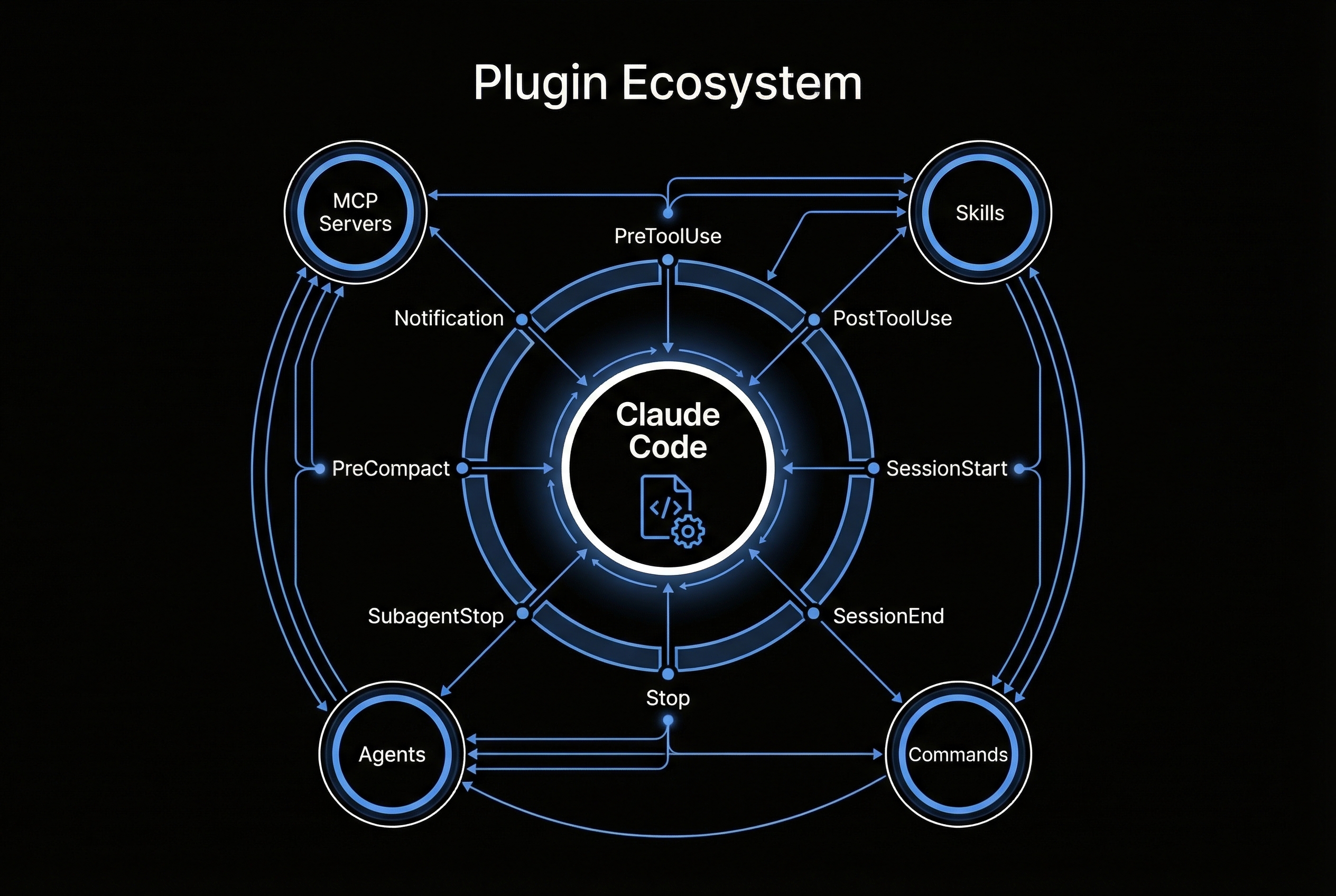
Eight lifecycle hooks give plugins surgical control over every phase of agent execution. From intercepting tool calls to managing session state, the plugin system makes BulletproofSoftware.tech extensible at every level.
The 8 Lifecycle Hooks
Every meaningful event in the agent lifecycle has a corresponding hook.
How It Works
A deterministic event-driven pipeline from trigger to response.
Event Occurs
A tool call, session change, compaction, or notification triggers a lifecycle event
Hook Intercepts
Registered plugins matching the event type are invoked in priority order
Plugin Executes
Plugin logic runs with full context — tool name, arguments, session state, and history
Result Returned
Modified context, approval decisions, or injected instructions flow back to the agent
Key Capabilities
Five extension points, one unified manifest.
8 Lifecycle Hooks
Intercept tool calls before and after execution, manage session start/end, handle compaction events, catch agent stop signals, and route notifications. Each hook receives rich context and can modify, approve, or block the operation.
Skills Framework
SKILL.md definitions with progressive disclosure — skills reveal capabilities as they become relevant, rather than dumping all instructions upfront. Markdown-based authoring means non-developers can create and maintain skills.
Agent Definitions
Markdown-based agent definitions with capability specifications, trust boundaries, and tool allowlists. Agents are composable — a security-review agent can delegate to a code-analysis agent while maintaining its own governance context.
Command System
Slash commands with YAML frontmatter define triggers, argument schemas, and execution targets. Commands can invoke skills, spawn agents, or execute direct operations. Argument validation happens before execution, not during.
MCP Integration
Model Context Protocol servers connect external services — databases, APIs, file systems, cloud providers — as first-class tools. MCP servers register via the plugin manifest and are discoverable by all agents in the system.
Plugin Manifest
The plugin.json schema registers all components: hooks, skills, agents, commands, and MCP servers. One file declares everything a plugin provides, what it requires, and how it should be loaded. No implicit dependencies.
Why It Matters
AI agents are only as useful as the systems they can interact with. A code assistant that cannot read your database schema, check your CI pipeline, or reference your internal documentation is limited to what fits in a context window.
The plugin ecosystem solves this by making every integration point explicit and composable. Eight lifecycle hooks mean plugins can enforce security policies (PreToolUse), log audit trails (PostToolUse), restore session context (SessionStart), and save learnings before compaction (PreCompact) — all without modifying core agent logic.
The result is a system that grows with your organization. Add a new data source by registering an MCP server. Add a new capability by writing a skill. Add a new workflow by defining a command. No core changes required.